
THE WHIP-STITCH PERIMETER
A Rhythm That Returns
The stitch kept returning before I understood why.
I recognized its rhythm in different places: in the raised mouldings of French boiserie, in the repeated lines of Fabergé’s guilloché, and in Dominica, where makers transformed natural materials into baskets, walls, and objects for daily life.
None of these was the same technique. Yet each revealed something familiar: repetition could give an edge rhythm, and the way something was joined did not need to disappear.
When I brought the whip-stitch into my own work, I did not want it to remain quiet.
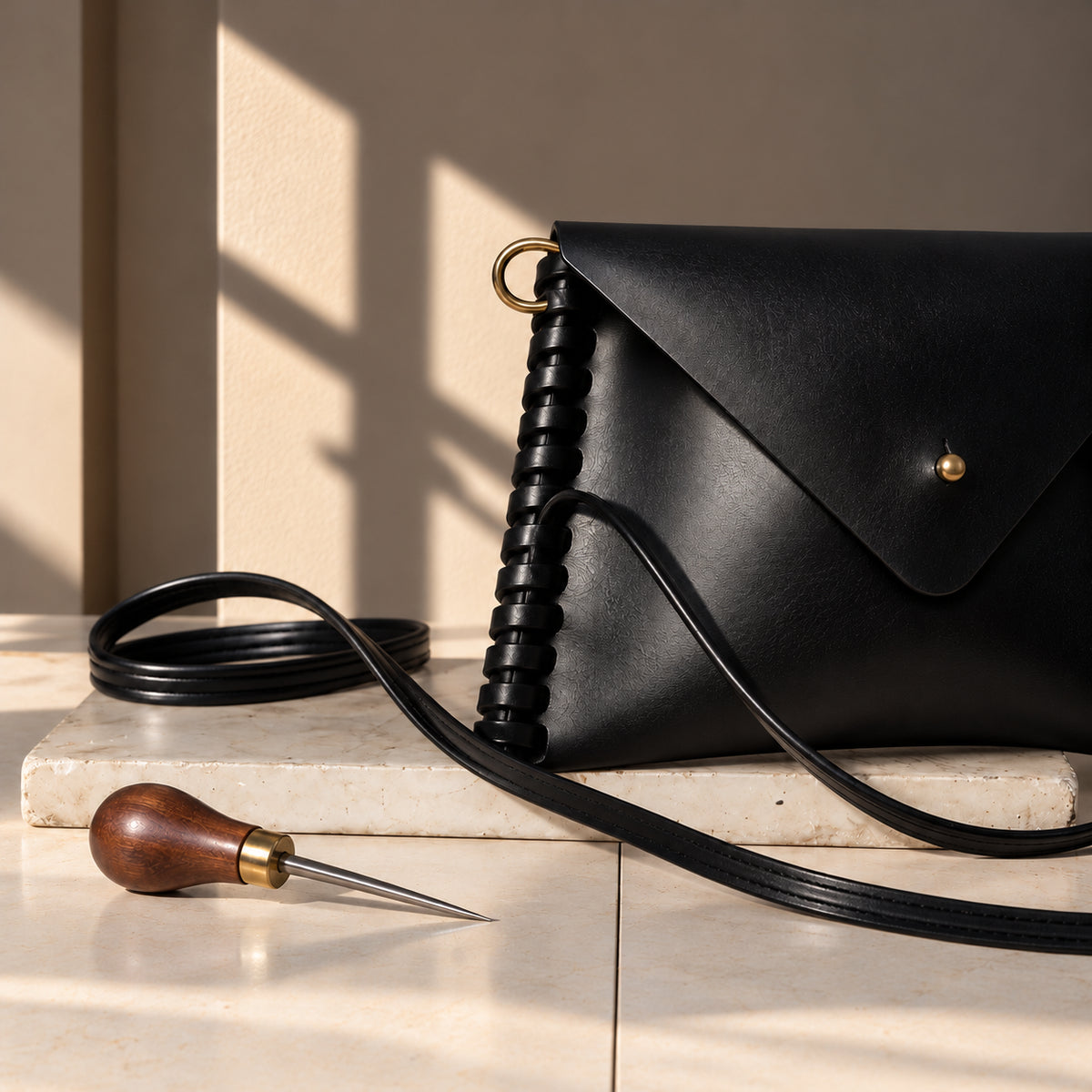
I enlarged the gesture, gave it greater volume, and allowed it to rise from the surface. What had traditionally served as a functional stitch became a defining architectural element of the object.
The leather is pierced by hand, and a broad leather lace moves continuously around its perimeter. Each passage follows the next, joining separate surfaces until the line returns to where it began.
That return matters.
It reminds me of the intelligence of hands I observed growing up in Dominica. Materials were gathered, cut, folded, and interlaced. Strength emerged through repetition, each element relying upon another.
The whip-stitch does not reproduce those traditions. Its connection is more instinctive, reflecting an understanding that beauty and usefulness can emerge from the same gesture.
Within John Xavier, the perimeter is not an embellishment added after construction. It is the construction itself, joining the leather, reinforcing the silhouette, and giving the object its recognizable presence.
From a distance, the stitch establishes the form. Up close, it reveals the hand.
Light moves across each raised passage, creating a rhythm of shadow and illumination. Subtle variations remain as evidence of pressure, judgment, and time.
The whip-stitch was not invented here. It was observed, questioned, and reinterpreted through proportion, material, and repetition.
Its purpose is to hold. Its rhythm gives the object identity.
The stitch does not decorate the union. It makes the union visible.

